
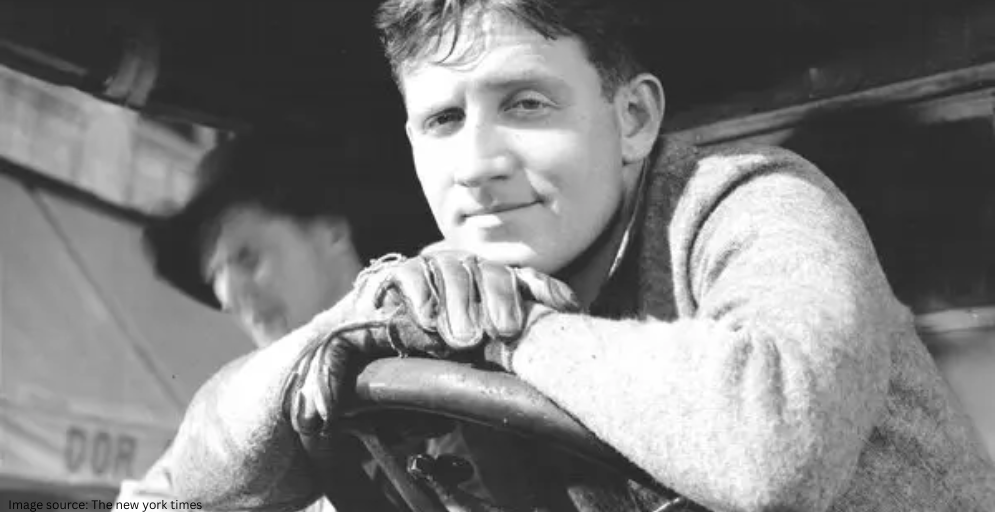
Spencer Bonaventure Tracy (April 5, 1900 – June 10, 1967) was an American actor widely regarded as one of Hollywood’s greatest male performers. Known for his natural acting style, emotional depth, and versatility across dramatic and comedic roles, Tracy became the first actor in history to win two consecutive Academy Awards for Best Actor, from a total of nine nominations throughout his 37-year career.
At the time of his death at age 67, Tracy’s net worth was estimated at approximately $10 million—a substantial fortune built primarily through his two decades at Metro-Goldwyn-Mayer (MGM), where he was one of the studio’s highest-paid and most reliable stars.
Off-screen, Tracy was a complex figure marked by both tremendous talent and personal struggle. He was married to Louise Treadwell from 1923 until his death, yet he maintained a celebrated 26-year affair with actress Katharine Hepburn—a relationship that was an open secret in Hollywood and resulted in nine films made together.
His later years were overshadowed by severe health decline stemming from heart disease, emphysema, diabetes, and a lifelong battle with alcoholism that both MGM’s executives and Hepburn worked tirelessly to manage. Despite these challenges, Tracy never lost his power as an actor, delivering a career-defining performance in his final film, Guess Who’s Coming to Dinner, just 17 days before his death.
Quick Facts About Spencer Tracy
| Attribute | Details |
| Full Name | Spencer Bonaventure Tracy |
| Birth Date | April 5, 1900 |
| Death Date | June 10, 1967 (age 67) |
| Birthplace | Milwaukee, Wisconsin, USA |
| Death Place | Beverly Hills, California, USA |
| Nationality | American |
| Spouse | Louise Treadwell (m. 1923–1967) |
| Children | Louise & John Ten Broeck Tracy |
| Profession | Actor, Theatrical & Film |
How Old Was Spencer Tracy? Age and Date of Birth (1900–1967)
Spencer Tracy was 67 years old when he died on June 10, 1967, in Beverly Hills, California. He was born on April 5, 1900, in Milwaukee, Wisconsin, making him a Taurus—a sign associated with determination, reliability, and emotional strength, qualities that defined his approach to his craft.
Tracy’s birth year placed him squarely in the first generation of Hollywood’s Golden Age. When he was born, silent cinema was still in its infancy; by the time he launched his film career in 1930, the industry had transformed with the advent of sound.
This unique generational positioning allowed him to witness and adapt to perhaps the most dramatic transformation in entertainment history. He was only 30 years old when he made his feature film debut, which meant his entire career arc—from unknown stage actor to two-time Oscar winner—unfolded over four decades of continuous industry evolution.
His age at death raises the haunting question of what else he might have accomplished had he lived longer. At 67, Tracy was still capable of delivering powerful performances, as evidenced by Guess Who’s Coming to Dinner. Industry observers at the time noted that had his health permitted, he likely would have continued working for another decade or more, possibly accumulating even more Academy Award nominations and wins.
Spencer Tracy Early Life, Family and Childhood
Spencer Tracy was one of the best actors in the 50s, born into a middle-class Irish-American family in Milwaukee, Wisconsin, a city that would profoundly shape his character and work ethic. His father, John Edward Tracy, was a truck salesman of Irish descent, while his mother, Caroline Brown Tracy, came from an English Protestant background.
The family lived at 3871 North Edgehill Avenue in Milwaukee, in a neighborhood populated largely by Irish immigrants and their descendants. This working-class, immigrant community instilled in young Spencer values of hard work, discipline, and no-nonsense pragmatism—traits that would become hallmarks of his acting style.
As the second son in the family, Spencer grew up alongside his older brother Carroll. The Tracy household was reportedly traditional and somewhat strict by early 20th-century American standards. John Edward Tracy worked steadily, providing a modest but stable income, while Caroline managed the household with discipline and care. Though not wealthy, the family was solidly respectable, and Spencer was expected to pursue a respectable profession.
The Midwest values of his upbringing—directness, honesty, and a skepticism toward pretense—became so ingrained in Tracy’s personality that he carried them throughout his life, even as he navigated the more theatrical world of Hollywood. Colleagues frequently remarked that Tracy had a Midwestern frankness and lack of affectation that distinguished him from more temperamental actors of the era
There is limited public information about Tracy’s childhood experiences, but it is clear that he was raised during a period of significant social and economic change in America. The Industrial Revolution was reshaping Milwaukee, transforming it into one of America’s major manufacturing hubs. This environment of growth, opportunity, and working-class solidarity would have influenced his worldview.
By his teenage years, Spencer had shown an early interest in drama and performance, interests that his family did not initially encourage, viewing acting as a precarious and morally questionable profession. It was not until he attended Ripon College in Wisconsin (1918–1922) that he seriously committed to drama and began to develop the skills that would eventually make him one of the greatest actors of the 20th century.
Spencer Tracy Career Journey and Breakthrough Role
Spencer Tracy’s path to stardom was neither quick nor easy. After graduating from Ripon College, he moved to New York City in 1922 to pursue theater, performing in stage productions while supporting himself with various jobs. He appeared in numerous theatrical productions throughout the 1920s, slowly building a reputation as a skilled, understated actor on Broadway.
His early roles were often minor parts in forgettable productions, yet he used each opportunity to refine his craft and develop the naturalistic acting style that would eventually distinguish him from his contemporaries.
Tracy’s first feature film role came in 1930 with Up the River, directed by John Ford—a remarkable debut that paired him with a then-unknown Humphrey Bogart. The film was a modest success, and it opened the door to Hollywood. However, true stardom did not arrive immediately.
Throughout the early 1930s, Tracy worked steadily in both films and theater, gradually building his filmography and honing the naturalistic, unaffected performance style that became his trademark. He refused the typical leading-man vanity of the era, preferring roles that allowed him to explore complex, flawed characters rather than play romantic ideals.
His breakthrough came in the mid-1930s with films like San Francisco (1936) and particularly Captains Courageous (1937), in which he played the gruff sea captain Disko. In that role, Tracy demonstrated the emotional range and authentic presence that captivated audiences and critics alike.
His performance was so powerful that he won the Academy Award for Best Actor at age 37—and then won again the following year for Boys Town (1938), becoming the first actor in history to win consecutive Best Actor Oscars. This remarkable achievement established him as one of Hollywood’s elite, and from that point forward, he was in constant demand by studios and top directors.
After his Oscar victories, Tracy was signed to a long-term contract with MGM, where he would remain for the next 20 years. He became the studio’s most reliable star, known for his professionalism, preparation, and ability to deliver powerful performances across diverse genres—drama, comedy, historical epic, and social commentary. His career trajectory demonstrates that success in Hollywood did not require overnight fame or the patronage of a single mentor, but rather talent, persistence, and an unwillingness to compromise artistic integrity for commercial appeal.
Spencer Tracy Movies and Filmography
| Film Title | Year | Role | Co-Stars |
| Up the River | 1930 | Criminals | Humphrey Bogart |
| San Francisco | 1936 | Father Mullin | Clark Gable, Jeanette MacDonald |
| Captains Courageous | 1937 | Captain Disko | Freddie Bartholomew, Lionel Barrymore |
| Boys Town | 1938 | Father Flanagan | Mickey Rooney |
| Woman of the Year | 1942 | Sam Craig | Katharine Hepburn |
| Adam’s Rib | 1949 | Adam Bonner | Katharine Hepburn |
| Father of the Bride | 1950 | Stanley Banks | Elizabeth Taylor, Joan Bennett |
| Bad Day at Black Rock | 1955 | John J. Macreedy | Robert Ryan, Anne Francis |
| The Old Man and the Sea | 1958 | Santiago | Felipe Pazos, Harry Bellaver |
| Inherit the Wind | 1960 | Henry Drummond | Fredric March, Gene Kelly |
| Judgment at Nuremberg | 1961 | Judge Dan Haywood | Burt Lancaster, Montgomery Clift |
| It’s a Mad, Mad, Mad, Mad World | 1963 | Captain Culpeper | Stuart Whitman, Ethel Merman |
| Guess Who’s Coming to Dinner | 1967 | Matt Drayton | Katharine Hepburn, Sidney Poitier |
Best Spencer Tracy Movies — Quick Ranked List
• Guess Who’s Coming to Dinner (1967) — Tracy’s final film performance, a moving commentary on race relations and family acceptance that earned him a posthumous Oscar nomination; his final scene remains one of cinema’s most powerful moments.
• Judgment at Nuremberg (1961) — A profound courtroom drama about post-WWII war crimes trials, featuring Tracy as Judge Haywood; showcases his ability to convey moral weight and judicial wisdom.
• Inherit the Wind (1960) — Tracy’s Henry Drummond in this adaptation of the Scopes Monkey Trial is a masterclass in naturalistic performance; a role that allowed him to explore the intersection of faith, science, and human dignity.
• Bad Day at Black Rock (1955) — A tense Western with Tracy as the one-armed John J. Macreedy, demonstrating his ability to dominate a frame and carry a film almost single-handedly despite a physical limitation.
• Captains Courageous (1937) — His Academy Award-winning role as the salty sea captain; a performance so authentic that it launched him to stardom and remains a benchmark for the type of character acting that became his specialty.
Spencer Tracy Awards and Achievements
| Award | Film/Role | Year | Result |
| Academy Award – Best Actor | Captains Courageous | 1938 | WON |
| Academy Award – Best Actor | Boys Town | 1939 | WON |
| Academy Award – Best Actor | Judgment at Nuremberg | 1962 | Nominated |
| Academy Award – Best Actor | Guess Who’s Coming to Dinner | 1968 | Nominated |
| Golden Globe Award | Multiple roles | Various | Multiple wins |
Spencer Tracy’s award legacy is extraordinary and continues to be unmatched in many respects. He received nine Academy Award nominations for Best Actor, winning twice—for Captains Courageous (1937) and Boys Town (1938)—making him the first actor in history to win consecutive Best Actor Oscars. This achievement stands as a testament to the consistency of his talent and the respect he commanded from the Academy and his peers.
Beyond the Oscars, Tracy won numerous Golden Globe Awards and was recognized by virtually every major film academy and critics’ organization during his lifetime. He was nominated for Academy Awards in later years for films like Judgment at Nuremberg and Guess Who’s Coming to Dinner, demonstrating that his power as an actor never diminished, even as his health declined.
His final nomination came posthumously for Guess Who’s Coming to Dinner, released in December 1967, just months after his death, ensuring that his legacy would conclude with recognition for one of his most meaningful performances.
Spencer Tracy Wife and Relationships — Louise Tracy & Katharine Hepburn
| Partner Name | Period | Duration | Status / Notes |
| Louise Treadwell (Wife) | 1923 – 1967 | 44 yrs | Married (never divorced) |
| Katharine Hepburn | 1936 – 1967 | 31 yrs | Long-term affair, Hollywood’s most famous |
Spencer Tracy’s personal relationships defined much of his life story and remain central to understanding his character and his work. He was married to Louise Treadwell in 1923, shortly after returning from service in World War I. Louise was a stage actress and dancer, and their marriage was, by all accounts, initially loving and committed.
Together they had two children: a daughter named Louise (born 1924) and a son named John Ten Broeck Tracy (born 1926). John, tragically, was born deaf—a reality that profoundly affected Spencer throughout his life and contributed to his deep personal anguish and, by some accounts, to his struggles with alcohol.
Despite the presence of their children, Tracy and Louise’s marriage became increasingly strained during the 1930s and 1940s.
The turning point came in 1942 when Tracy met Katharine Hepburn on the set of Woman of the Year. Hepburn was a strong, independent, intellectually fierce actress, and she and Tracy formed an immediate, powerful connection. What began as a professional collaboration evolved into one of Hollywood’s most celebrated—and most complicated—affairs. The two would go on to make nine films together and maintain a relationship that lasted until Tracy’s death 25 years later.
Tracy never divorced Louise, due in large part to his devout Catholic faith and his strong belief that marriage was a sacred sacrament that should not be dissolved. Katharine Hepburn, respecting this belief and understanding Tracy’s complicated loyalty to his wife and children, remained in the relationship despite the fact that she could never be Tracy’s legal spouse. This arrangement was an open secret in Hollywood—everyone in the industry knew of their relationship, though the general public was largely unaware or chose not to confront the reality.
By all accounts, Hepburn was devoted to Tracy in a way that transcended typical romantic love. She served as his caretaker during his periods of alcohol-fueled illness, managed his professional commitments, supported his career decisions, and provided emotional stability during his most difficult years. When asked in later interviews why she remained with him despite his alcoholism and refusal to divorce his wife, she famously stated simply: ‘I could never change him, and I wouldn’t have wanted to.
He was the love of my life.’ She added that she understood Tracy’s faith was as integral to his identity as his talent, and she would never ask him to violate his conscience, even for the sake of their relationship.
When Spencer Tracy died in 1967, Katharine Hepburn did not attend his funeral, respecting his wife’s need for family privacy and avoiding a public scandal that would have overshadowed the solemnity of the occasion.
However, she did privately visit the mortuary that morning to say goodbye to him, a moment of personal grief that she kept largely private. Their relationship, though unconventional by the standards of their time, is now recognized as one of the great love stories of Hollywood’s Golden Age—a testament to the complexity of human connection, the power of artistic partnership, and the triumph of authentic love over social convention.
Spencer Tracy Net Worth at Death (1967) and Income Sources
| Asset / Income Type | Details | Estimated Value |
| Net Worth at Death (1967) | Acting career + estate | ~$10 Million (1967) |
| MGM Salary (Peak Years) | Highest-paid actor at MGM | $300,000+ per film |
| Film Residuals | Broadcasting and re-releases | Ongoing income stream |
| Estate Value (2026 equivalent) | Adjusted for inflation from 1967 | ~$75–90 Million in today’s dollars |
At the time of his death on June 10, 1967, Spencer Tracy’s net worth was estimated at approximately $10 million—a substantial fortune by 1960s standards, equivalent to roughly $75–90 million in 2026 dollars when adjusted for inflation. This wealth was accumulated almost entirely through his career as an actor, making him one of the highest-paid entertainers of his era.
Tracy’s rise to financial prominence was closely tied to his success at MGM. During the 1940s and 1950s, when he was in his peak earning years, he commanded salaries of $300,000 or more per film—an astronomical sum for the period. MGM, recognizing his box-office appeal and artistic credibility, invested heavily in his pictures and protected their investment through careful management of his personal life and his drinking episodes.
The studio’s secret ‘Tracy Squad’—composed of doctors, drivers, security personnel, and handlers—was deployed to manage his binges and keep him functional enough to fulfill his contractual obligations.
Beyond his salaries, Tracy benefited from the residual income that came with the re-release of his films and, later, from television broadcasts of his movies. His most celebrated films, such as Father of the Bride and It’s a Mad, Mad, Mad, Mad World, remained popular draws and continued to generate revenue long after their theatrical releases.
Additionally, Tracy’s name became sufficiently valuable that his mere attachment to a project could attract financing and audiences, allowing him to negotiate increasingly favorable terms as his career progressed.
His wealth, while significant, was not accumulated without cost.
Much of his income during his later years was spent on medical care, hospitalizations for alcohol-related illnesses, and the discreet payments made by MGM executives to cover up various incidents and scandals. By the 1960s, despite his continued earning power, his net worth was being eroded by declining health, reduced work capacity, and the accumulated expenses of a life lived in the public eye with the constant threat of exposure.
Lesser Known Facts About Spencer Tracy
• MGM’s Secret ‘Tracy Squad’: Metro-Goldwyn-Mayer employed a dedicated team of doctors, security guards, and handlers specifically assigned to manage Spencer Tracy’s alcohol binges. This squad would intervene when he started drinking, arranging hospitalizations, paying off witnesses, and ensuring he was sober enough to report to the set for filming. The studio viewed him as too valuable an asset to lose, so they invested significant resources in keeping his drinking problems out of the public eye and ensuring he could continue working.
• His Binge Drinking Pattern: Unlike many alcoholics of the era, Tracy was not a daily drinker. Instead, he was a periodic binge drinker who could remain sober for weeks or months before a single drink triggered a multi-day or multi-week drinking bender. These binges would leave him physically ill, emotionally unstable, and professionally unreliable. According to accounts from colleagues and Katharine Hepburn, these patterns intensified in his later years as his health declined.
• His Son’s Deafness and Lifelong Guilt: Spencer’s son John was born profoundly deaf in 1926, a condition that Tracy viewed as a personal failure and tragedy. Throughout his life, Tracy carried deep guilt over his son’s disability, believing it was somehow connected to his own life choices or spiritual failings. This guilt was compounded by his Catholic faith and became one of the psychological sources of his depression and drinking. He devoted considerable energy and resources to supporting deaf education and organizations throughout his life, channeling his grief into philanthropy.
• His Final Film Shot in Near-Death Health: During the filming of Guess Who’s Coming to Dinner in 1967, Spencer Tracy’s health was so fragile that he was barely able to work. The production had to be carefully scheduled, with all his scenes shot between 9 a.m. and noon, allowing him to rest during the afternoon. Because the studio and insurance companies were uncertain he would survive the filming, director Stanley Kramer and co-star Katharine Hepburn placed their own salaries into escrow as insurance that the film would be completed. Tracy died just 17 days after finishing his final scene.
• Natural Acting Pioneer: Tracy was one of the first major actors to employ what would later be called ‘method acting,’ long before it became codified by Lee Strasberg and the Actor’s Studio. Rather than theatrical gesticulation or stage projection, Tracy believed in finding the emotional truth of a character and performing with naturalistic restraint. He would famously say that the best acting should be ‘invisible,’ with the actor disappearing entirely into the character. This approach influenced generations of actors and marked a philosophical shift in American acting.
• His Refusal of Leading-Man Vanity: Unlike many of his contemporaries, Tracy refused roles that required him to be the romantic lead or to be lit and photographed in ways designed purely to enhance his physical appearance. He believed that good acting required the actor to serve the story and the character, not the other way around. This attitude, unusual for major male stars of the era, earned him respect from serious directors and critics, though it sometimes limited his box-office appeal compared to more conventionally handsome leading men.
• His Battle with Multiple Serious Illnesses: By his 60s, Tracy was simultaneously battling heart disease, emphysema, diabetes, and the cumulative effects of decades of heavy drinking. Each condition worsened the others, creating a downward spiral of physical decline. His doctors were amazed that he remained as functional as he did, and his determination to continue working despite his deteriorating health is testimony to both his professional dedication and his personal demons.
Frequently Asked Questions About Spencer Tracy
Who was Spencer Tracy’s wife?
Spencer Tracy was married to Louise Treadwell from 1923 until his death in 1967—a 44-year marriage that produced two children. However, he is far more famous for his 26-year relationship with actress Katharine Hepburn, whom he met on the set of Woman of the Year in 1942. Despite his love for Hepburn and their deep personal and professional partnership, Tracy never divorced Louise due to his devout Catholic faith, which forbade divorce.
Why didn’t Katharine Hepburn go to Spencer Tracy’s funeral?
Katharine Hepburn did not attend Spencer Tracy’s funeral in June 1967 out of respect for his wife, Louise, and to avoid creating a public scandal that would have drawn attention to the affair and away from the family’s private grief. However, she did privately visit the mortuary earlier that morning to say a personal goodbye before his casket was transferred to the hearse. She later stated simply: ‘It was his family’s time.’ This decision reflected her deep respect for Tracy’s family and his faith, even at the cost of her own public grieving.
Was Spencer Tracy a heavy drinker?
Yes, Spencer Tracy struggled with severe alcoholism throughout his adult life. Rather than drinking daily, he was a periodic binge drinker who could go weeks or months sober before a single drink triggered multi-day or multi-week binges. During these binge episodes, he would be physically ill, emotionally volatile, and unable to work. MGM employed a secret ‘Tracy Squad’ of doctors, drivers, and security personnel specifically to manage his drinking episodes and keep them out of the public eye. According to accounts, his drinking worsened in his later years as his health declined.
What was Spencer Tracy’s illness when he died?
Spencer Tracy died of a heart attack on June 10, 1967, at age 67. His death was the result of multiple serious health conditions he had battled for decades: severe heart disease, emphysema (likely from lifelong smoking), diabetes, and the cumulative physical damage from lifelong alcoholism. His health was so fragile during the filming of his final movie, Guess Who’s Coming to Dinner, that all his scenes had to be filmed before noon to allow him to rest during afternoons. He collapsed and died just 17 days after completing his final scene.
What was Spencer Tracy’s net worth at death?
At the time of his death in 1967, Spencer Tracy’s net worth was estimated at approximately $10 million—equivalent to roughly $75–90 million in 2026 dollars when adjusted for inflation. His wealth came primarily from his two decades at MGM, where he was one of the highest-paid actors in Hollywood, commanding salaries of $300,000 or more per film during his peak years. Despite his substantial earnings, much of his income in later years was spent on medical care and hospitalizations related to his health issues.
What were Spencer Tracy’s best movies?
Spencer Tracy’s most celebrated films include Guess Who’s Coming to Dinner (1967), his final and career-defining role; Judgment at Nuremberg (1961), a profound courtroom drama about post-WWII war crimes trials; Inherit the Wind (1960), an exploration of the Scopes Monkey Trial; Bad Day at Black Rock (1955), a Western that showcased his ability to dominate a frame; and Captains Courageous (1937), the Academy Award-winning role that launched him to stardom. He was the first actor to win two consecutive Academy Awards for Best Actor, for Captains Courageous and Boys Town (1938).
How old was Spencer Tracy when he died?
Spencer Tracy was 67 years old when he died on June 10, 1967, in Beverly Hills, California. He was born on April 5, 1900, in Milwaukee, Wisconsin, meaning he had just passed his birthday two months before his death. Despite his age and declining health, he delivered one of the finest performances of his career in Guess Who’s Coming to Dinner, which was released in December 1967, months after his death.
Why did Katharine Hepburn stay with Spencer Tracy for 26 years?
According to Katharine Hepburn’s own accounts, she stayed with Spencer Tracy because of her profound and unwavering love for him. She was devoted to protecting him, caring for him during his periods of illness, managing his alcohol-related crises, and supporting him through his professional and personal struggles. When asked why she didn’t leave despite his alcoholism and refusal to divorce his wife, she stated: ‘I could never change him, and I wouldn’t have wanted to. He was the love of my life.’ She deeply respected Tracy’s Catholic faith, which prevented him from divorcing Louise, and she accepted that she would never be his legal wife. Their relationship, though unconventional, is now recognized as one of Hollywood’s great love stories.
More Golden Age Hollywood Actors You Might Like
• Katharine Hepburn (1907–2003) — American actress and Tracy’s greatest collaborator; appeared in 9 films with him, including Woman of the Year and Guess Who’s Coming to Dinner; known for fierce intelligence and independence.
• Elizabeth Taylor (1932–2011) — British-American actress and Tracy’s co-star in Father of the Bride; one of Golden Age Hollywood’s most glamorous and talented stars.
• Sidney Poitier (1927–) — Groundbreaking American actor and Tracy’s co-star in Guess Who’s Coming to Dinner; first Black male actor to win an Academy Award for Best Actor.
• Humphrey Bogart (1899–1957) — American actor and Tracy’s co-star in their shared debut film Up the River; iconic figure of Golden Age Hollywood and film noir.









Leave a Reply