
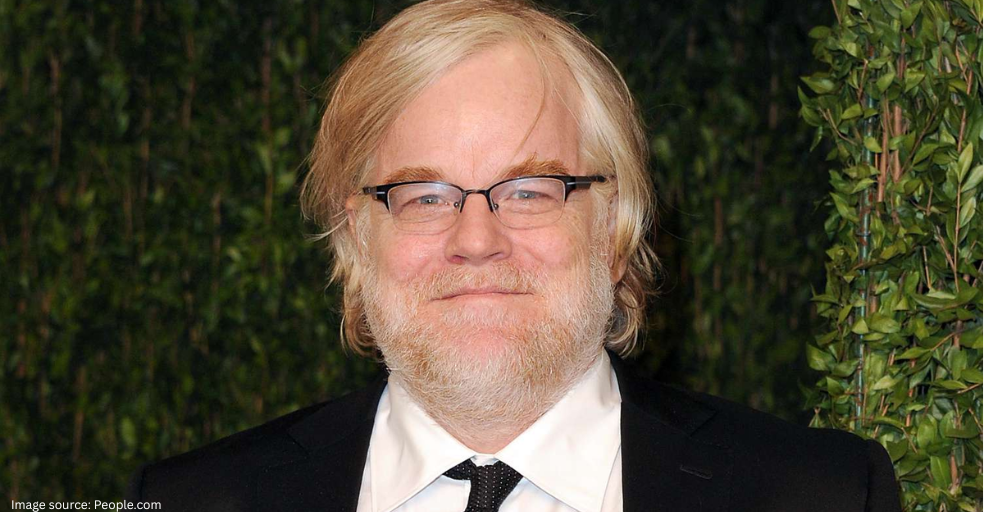
Philip Seymour Hoffman (July 23, 1967 – February 2, 2014) was an acclaimed American actor, director, and theater performer best known for his distinctive character roles in films such as Capote, The Master, and Before the Devil Knows You’re Dead.
With an Oscar win, multiple Tony nominations, and a reputation for depth and authenticity, Hoffman was widely regarded as one of the finest actors of his generation. His sudden death in February 2014 at age 46, following a heroin overdose, shocked the entertainment industry and left a profound legacy in cinema and theater. Despite his personal struggles with addiction, Hoffman’s body of work remains a testament to his extraordinary talent and commitment to complex, meaningful roles.
Philip Seymour Hoffman Birth, Death, and Legacy (1967–2014)
Birth & Early Years
Philip Seymour Hoffman was born on July 23, 1967, in Fairport, New York, a suburb of Rochester. His mother, Marilyn O’Connor, was a lawyer and philanthropist. His father, Gordon S. Hoffman, worked in the insurance industry. Raised in a supportive, intellectually engaged household, Hoffman showed early signs of creative ambition. His parents encouraged artistic pursuits, which would later manifest in his dedication to acting and character development. Growing up in upstate New York during the 1970s and early 1980s, Hoffman developed a strong work ethic and introspective personality—traits that would become hallmarks of his acting career.
Date & Circumstances of Death
On February 2, 2014, Philip Seymour Hoffman was found dead in his apartment in Manhattan’s West Village at approximately 11:15 a.m. He was discovered by his assistant. The New York City Medical Examiner’s Office ruled his death an accidental overdose caused by acute mixed drug intoxication, involving heroin, cocaine, amphetamine, and benzodiazepines.
The tragedy occurred amid his ongoing struggle with addiction—a battle he had fought publicly and privately for decades. Hoffman had been sober for 23 years before a relapse during the filming of The Master (2012), an event that friends and colleagues noted as a turning point in his final years.
Legacy & Industry Impact
His death reverberated throughout Hollywood. Directors, co-stars, and critics paid tribute to his unparalleled artistry. The film and theater communities mourned the loss of a generational talent at the height of his creative powers.
Several films featuring Hoffman were released posthumously, including his final performances in The Hunger Games: Mockingjay Part 2 (2015). His son, Cooper Hoffman, later followed in his father’s footsteps, becoming an actor himself. Philip Seymour Hoffman’s legacy is marked not only by his awards and iconic roles but by his influence on an entire generation of actors who studied his craft and sought to emulate his depth and authenticity.
Philip Seymour Hoffman Early Life, Family, and Childhood in New York
Philip Seymour Hoffman’s childhood in Fairport, New York, was marked by intellectual curiosity and creative exploration. His mother’s career in law and his father’s business background created a household that valued both achievement and thoughtful analysis.
Hoffman was the only child to receive such focused parental investment, and this may have contributed to his introspective nature. During his teenage years, he began experimenting with acting in school productions, discovering a passion for performance that would dominate his adult life. He was a shy, introspective teenager—traits that paradoxically would make him exceptional at portraying complex, emotionally vulnerable characters on stage and screen.
In high school, Hoffman participated in drama clubs and developed close friendships with other artistically inclined students. His height (5’10”) and unconventional appearance meant he was never cast in traditional leading roles, instead being drawn to character work that required depth rather than conventional attractiveness.
This early misdirection—being ‘too quirky’ for mainstream roles—actually shaped his artistic sensibility. After high school, Hoffman attended New York University’s Tisch School of the Arts, one of the nation’s most prestigious acting programs, where he trained rigorously under some of the industry’s most respected acting coaches.
Philip Seymour Hoffman Career Journey: Theater to Oscar-Winning Films
Philip Seymour Hoffman’s professional career began in theater in the late 1980s and early 1990s. After graduating from NYU Tisch, he performed in Off-Broadway productions and regional theater, building a reputation as a serious, dedicated actor willing to take on unglamorous roles. His theater work earned him Tony Award nominations for Death of a Salesman (2012), True West (2002), and Long Day’s Journey Into Night (2003). These stage performances showcased his range and his ability to inhabit psychological complexity—a skill that would define his film career.
His film debut came in 1991 with Triple Bogey on a Par Five Hole, an uncredited minor role. Throughout the 1990s, he appeared in supporting roles in films like Twister (1996) and Boogie Nights (1997), where he played Scotty J., a memorable supporting character that caught critics’ attention. His breakthrough came in the late 1990s and early 2000s with roles in Magnolia (1999), The Talented Mr. Ripley (1999), and Almost Famous (2000). Working with director Paul Thomas Anderson on Magnolia marked the beginning of a significant creative partnership that would produce some of his finest work.
In 2005, Hoffman delivered a transformative performance in Capote, portraying writer Truman Capote with such precision and emotional depth that he won the Academy Award for Best Actor—the pinnacle of his career. Following this Oscar win, he continued working with Anderson on The Master (2012), where his portrayal of Lancaster Dodd opposite Joaquin Phoenix showcased his ability to hold his own alongside equally talented leads.
Other notable films include Before the Devil Knows You’re Dead (2007), where director Sidney Lumet praised his acting as ‘one of the most extraordinary pieces of acting’ he had ever witnessed, and Doubt (2008), where he played a complex priest opposite Meryl Streep.
Philip Seymour Hoffman Filmography: Complete List of Major Movies
Philip Seymour Hoffman’s filmography spans theater, independent films, and major studio productions. Below are his most significant film roles:
| Film Title | Year | Character / Role | Co-Stars |
| Capote | 2005 | Truman Capote (Lead) | Catherine Keener |
| The Master | 2012 | Lancaster Dodd | Joaquin Phoenix, Amy Adams |
| Before the Devil Knows You’re Dead | 2007 | Andy Hanson | Ethan Hawke, Marisa Tomei |
| Doubt | 2008 | Father Flynn | Meryl Streep, Amy Adams |
| The Hunger Games | 2012 | Plutarch Heavensbee | Jennifer Lawrence, Josh Hutcherson |
| The Hunger Games: Mockingjay – Part 1 | 2014 | Plutarch Heavensbee | Jennifer Lawrence |
| Magnolia | 1999 | Phil Parma | Tom Cruise, Julianne Moore |
| Boogie Nights | 1997 | Scotty J. | Mark Wahlberg, Burt Reynolds |
| Mission: Impossible III | 2006 | Owen Davian (Villain) | Tom Cruise, Michelle Monaghan |
| Flawless | 1999 | Rusty Zimmerman | Robert De Niro |
| Twister | 1996 | Eldridge | Helen Hunt, Bill Paxton |
| Along Came Polly | 2004 | Stan Indursky | Ben Stiller, Jennifer Aniston |
| The Talented Mr. Ripley | 1999 | Freddy Miles | Matt Damon, Jude Law |
| Almost Famous | 2000 | Lester Bangs | Patrick Fugit, Kate Hudson |
Best Philip Seymour Hoffman Movies — Quick Ranked List
• Capote (2005) — His Oscar-winning masterpiece; a nuanced portrait of ambition, loneliness, and obsession.
• The Master (2012) — A towering performance opposite Joaquin Phoenix; complex, magnetic, unforgettable.
• Before the Devil Knows You’re Dead (2007) — A devastating turn in Sidney Lumet’s final film; proof of his range in dramatic roles.
• Magnolia (1999) — A career-defining role that established him as a serious dramatic actor.
• Doubt (2008) — Standing toe-to-toe with Meryl Streep; a psychological duel showcasing his subtlety and intelligence.
Philip Seymour Hoffman Awards: Oscar Win, Tony Nominations, SAG Awards
Philip Seymour Hoffman’s awards history reflects his status as one of the most respected actors of his time. His Oscar win for Capote (2005) was the peak of his acclaim, but his nominations and wins spanned film, television, and theater.
| Award | Year | Film / Role | Result |
| Academy Award | 2006 | Capote | WON – Best Actor |
| Golden Globe | 2006 | Capote | NOMINATED |
| BAFTA Award | 2006 | Capote | NOMINATED |
| SAG Award | 2006 | Capote | WON |
| Tony Award | 2012 | Death of a Salesman | NOMINATED |
| Tony Award | 2002 | True West | NOMINATED |
| Tony Award | 2003 | Long Day’s Journey Into Night | NOMINATED |
| Golden Globe | 2013 | The Master | NOMINATED – Best Supporting Actor |
| Independent Spirit Award | 2007 | Before the Devil Knows You’re Dead | NOMINATED |
Hoffman’s Capote performance remains one of the most celebrated acting achievements of the 2000s. Critics praised his ability to capture Capote’s distinctive mannerisms, voice, and psychological vulnerability.
Beyond acting awards, Hoffman was also honored for his work as a director and producer, having founded The LAByrinth Theater Company to develop new theatrical works. His lifetime of contributions to theater was recognized through various honors from arts organizations and educational institutions.
Philip Seymour Hoffman Partner: Children and Family Life
Philip Seymour Hoffman was in a long-term relationship with Mimi Rogers, an acclaimed actress known for her roles in films like The Rapture (1991) and Gung Ho (1986). Though they never married, Hoffman and Rogers built a committed partnership and had three children together:
Cooper Hoffman (born 2003), Tallulah Hoffman (born 2006), and Willa Hoffman (born 2008). Hoffman was a devoted father who fiercely protected his children’s privacy despite his own high public profile. Friends and colleagues frequently commented on his dedication to parenting, often turning down roles or adjusting his schedule to be present for his family.
Hoffman and Rogers kept their relationship remarkably private in an industry that thrives on celebrity gossip. They were rarely photographed together and gave few interviews about their personal life. In interviews, Hoffman spoke thoughtfully about fatherhood and the challenge of balancing a demanding acting career with his responsibility to his children.
After his death, Rogers became the custodial guardian of their three children. The family relocated away from Los Angeles’ spotlight, and Cooper has since become an actor himself, honoring his father’s legacy in the entertainment industry.
Philip Seymour Hoffman Net Worth at Death (2014) and Legacy Earnings
At the time of his death in February 2014, Philip Seymour Hoffman’s estimated net worth was approximately $35 million. This wealth was accumulated through his extensive work in film, television, theater, and production.
His Oscar-winning role in Capote significantly elevated his commercial value, allowing him to command higher fees for subsequent film roles. Major studio productions like The Hunger Games franchise and Mission: Impossible III contributed substantially to his earnings. His theater work, while not financially lucrative compared to film, was essential to his artistic identity and maintained his prestige as a serious performer.
Hoffman’s income sources included: (1) Major Hollywood film roles, especially post-Capote (estimated $15–20M+ over 8 years), (2) Theater productions and directing work (modest but prestigious), (3) Television appearances and documentaries, (4) Production company work through his involvement with The LAByrinth Theater Company. Beyond his death, Hoffman’s estate has continued to earn from streaming platform royalties, DVD sales, and television reruns of his films and the final Hunger Games films. His production company’s catalog of works has also generated posthumous income for his family and beneficiaries.
Lesser Known Facts About Philip Seymour Hoffman
• At age 22, Hoffman checked into rehab after struggling with alcohol and drug addiction during his years at NYU. He then remained sober for 23 years—a remarkable achievement that friends credited to his discipline and commitment to recovery—until his relapse during The Master in 2012.
• Hoffman was an accomplished director, having helmed several productions for The LAByrinth Theater Company, a nonprofit he co-founded to develop new plays and mentor emerging theater artists. This work was deeply meaningful to him and reflected his commitment to the craft beyond acting.
• For his role in Capote, Hoffman studied the writer obsessively, perfecting Capote’s distinctive speaking voice, mannerisms, and psychological complexity. He spent months observing archival footage and reading Capote’s work to fully embody the character.
• Director Sidney Lumet called Hoffman’s performance in the car scene with Marisa Tomei in Before the Devil Knows You’re Dead ‘one of the most extraordinary pieces of acting’ he had ever witnessed in his 60-year career—high praise from a legendary director.
• Hoffman suffered a back injury in 2013, for which he was prescribed opioids. Some reports suggest this prescription intensified his addiction struggles in his final months, highlighting the intersection of physical pain and substance abuse in his deteriorating condition.
• He was notoriously private about his personal life, rarely attending celebrity events and avoiding paparazzi. This discretion made him unique among major Hollywood stars and earned him respect from fellow actors who valued his focus on craft over celebrity culture.
Frequently Asked Questions About Philip Seymour Hoffman
How did Philip Seymour Hoffman die?
Philip Seymour Hoffman died on February 2, 2014, from a drug overdose at his home in Manhattan’s West Village. He was found by his assistant around 11:15 a.m. The New York City Medical Examiner’s Office ruled his death an accidental overdose caused by acute mixed drug intoxication, involving heroin, cocaine, amphetamine, and benzodiazepines. He was 46 years old.
What was the cause of Philip Seymour Hoffman’s death?
The cause was determined to be acute mixed drug intoxication. Hoffman had been sober for 23 years before his relapse began during the filming of The Master (2012). He struggled with addiction in his final years and, despite seeking help in 2013, could not overcome the disease. A back injury and prescription opioids may have intensified his substance abuse in his final months.
What are Philip Seymour Hoffman’s most famous movies?
His most celebrated films include Capote (2005, for which he won the Oscar), The Master (2012), Before the Devil Knows You’re Dead (2007), Doubt (2008), Magnolia (1999), and Boogie Nights (1997). Each showcased his distinctive talent for complex, character-driven roles that revealed deep psychological complexity.
Was Philip Seymour Hoffman in The Hunger Games?
Yes. Hoffman played Plutarch Heavensbee, the strategic leader of the rebel forces in The Hunger Games franchise. He appeared in The Hunger Games (2012) and The Hunger Games: Mockingjay – Part 1 (2014). He was posthumously featured in Mockingjay Part 2 (2015), having completed his scenes before his death.
Who was Philip Seymour Hoffman’s wife / partner?
Hoffman was in a long-term relationship with actress Mimi Rogers, with whom he had three children: Cooper, Tallulah, and Willa. He and Rogers never married but maintained a committed partnership for many years. Hoffman kept his personal life very private and rarely spoke publicly about his family.
What was Philip Seymour Hoffman’s first movie?
His first feature film role was in Triple Bogey on a Par Five Hole (1991), an uncredited minor part when he was 23 years old. His breakthrough supporting role came in Twister (1996), followed by Boogie Nights (1997), which established him as a serious character actor.
Why did Philip Seymour Hoffman relapse?
Hoffman had been sober for 23 years before accepting an alcoholic drink to celebrate completing The Master in 2012. This relapse triggered a return to drug use. The exact circumstances remain private, but he struggled with ongoing addiction during production and in the years following. In 2013, he sought treatment but ultimately could not sustain recovery before his death in early 2014.
Did Philip Seymour Hoffman win an Oscar?
Yes. Hoffman won the Academy Award for Best Actor in 2006 for his role as writer Truman Capote in the film Capote (2005). This was his only Oscar win, though he received numerous other accolades throughout his career, including SAG Awards, Golden Globe nominations, and Tony Award nominations.





Leave a Reply