
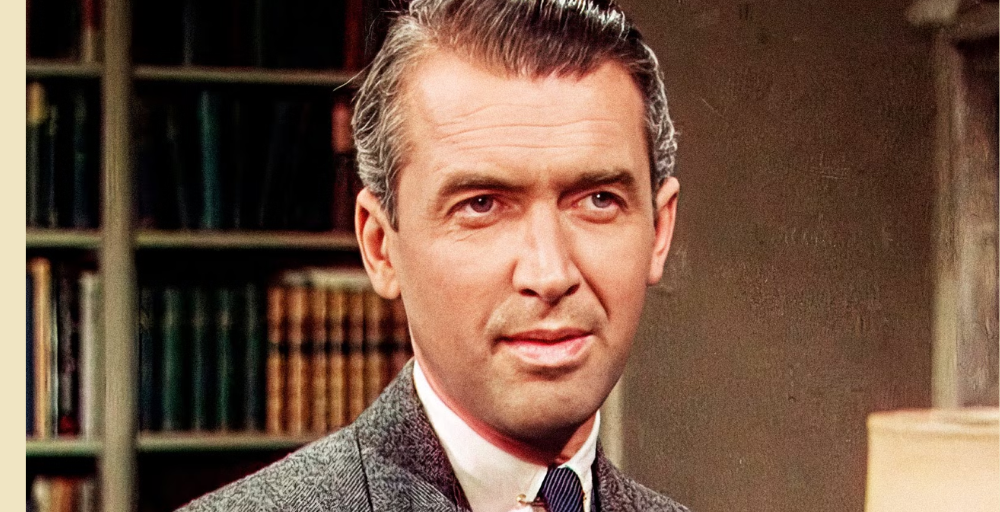
James Maitland Stewart (May 20, 1908 – July 2, 1997) was an American actor and decorated military aviator best known for It’s a Wonderful Life, Rear Window, and Vertigo. Over a six-decade career spanning 80 films, Stewart became the defining “everyman” of Hollywood’s Golden Age, equally at home in Frank Capra’s idealistic dramas and Alfred Hitchcock’s psychological thrillers.
At the time of his death, his net worth was estimated at roughly $30 million, built on acting earnings, pioneering profit-share film deals, and a string of outside investments. He was married only once, to Gloria Hatrick McLean, in a 45-year partnership that became one of the most enduring marriages in Hollywood history.
Beyond the screen, Stewart carried a real and rarely matched distinction: he flew combat missions as a U.S. Army Air Forces bomber pilot in World War II and retired from the Air Force Reserve as a Brigadier General — the highest military rank ever held by an American actor.
That wartime experience, and the toll it took on him, is widely believed to have shaped the raw, anguished performance he gave in It’s a Wonderful Life, the first film he made after coming home.
Quick Facts About James Stewart
| Attribute | Details |
| Full Name | James Maitland Stewart |
| Date of Birth | May 20, 1908 |
| Date of Death | July 2, 1997 (age 89) |
| Birthplace | Indiana, Pennsylvania, USA |
| Nationality | American |
| Height | 6’3″ (191 cm) |
| Zodiac Sign | Taurus |
| Profession | Actor; Brigadier General, U.S. Air Force Reserve |
| Spouse | Gloria Hatrick McLean (m. 1949–1994, her death) |
| Children | 4 — Michael, Ronald, Judy, Kelly |
| Net Worth at Death | ~$30 Million (estimates vary) |
How Old Was James Stewart? Age, Date of Birth and Death
James Stewart was born on May 20, 1908, in Indiana, Pennsylvania, and died on July 2, 1997, at age 89. He was a Taurus, a sign often associated with the steady, grounded reliability that became central to his on-screen persona.
A common search question is how old James Stewart was in It’s a Wonderful Life: production began in April 1946, when he was 37, and he turned 38 partway through filming — making him roughly 38 years old in the finished film, released that December. It was his first role after returning from the war, and audiences at the time noticed he looked visibly older and more weathered than the boyish star they remembered from before 1941.
He remained active well into his seventies, with his final on-screen acting role coming at 78 in the 1986 miniseries North and South, Book II, and his last performance overall — voicing the sheriff dog Wylie Burp — arriving in 1991 at age 83.
James Stewart Early Life, Family and Childhood
Stewart grew up in Indiana, Pennsylvania, the eldest child and only son of Alexander Maitland Stewart, who ran the family’s J.M. Stewart & Co. hardware store, and his wife Elizabeth. He had two younger sisters, Mary and Virginia, and was raised in a devoutly Presbyterian household that expected him, eventually, to take over the family business.
He had other plans. After attending Mercersburg Academy, where he played football, ran track, and sang in the glee club, Stewart enrolled at Princeton University in 1929 to study architecture — his senior thesis was reportedly on airport design, a early hint of his lifelong fascination with aviation. It was at Princeton, through the Triangle Club and later the University Players in Cape Cod, that he discovered acting, forming close, lasting friendships with fellow performers Henry Fonda and Margaret Sullavan.
After graduating in 1932, Stewart followed his theater friends to New York, making his Broadway debut that year in Carry Nation before landing a string of small stage roles. A contract with MGM brought him to Hollywood in 1935, where his unhurried, conversational delivery — unusual for the era — initially left studio executives unsure what to do with him.
James Stewart’s World War II Military Service
James Stewart was one of the only major Hollywood stars of his era to fly in actual combat during World War II. Just weeks after winning his only competitive Academy Award in early 1941, he enlisted in the U.S. Army — having been rejected once already for being underweight — and was assigned to the Army Air Corps, where his existing 300-plus hours as a licensed civilian pilot made him a natural fit.
For nearly two years, the military kept him stateside as a flight instructor, reluctant to risk a movie star’s life in combat. Stewart pushed back repeatedly, and in November 1943 he finally deployed to England as a squadron leader with the 445th Bomb Group, flying B-24 Liberator bombers over Nazi-occupied Europe. By the war’s end he had flown roughly 20 combat missions, been promoted to colonel, and earned the Distinguished Flying Cross, the Air Medal with Oak Leaf Clusters, and the French Croix de Guerre.
That service came at a steep personal cost. Biographers and surviving crewmates have described Stewart losing significant weight, sleeping poorly, and struggling after missions in which his unit suffered heavy losses — on one raid alone, ten crews under his command, 130 men, did not return. S
ome accounts, drawing on contemporary records of him being “flak happy,” describe this as what would today be recognized as combat-related PTSD; other military historians caution that the full picture is more complicated and that some popularized versions of the story overstate specific details.
What’s well documented is that Stewart rarely spoke about his combat experience for the rest of his life, and that he returned from the war a visibly changed man — a fact many critics connect directly to the unusually raw, anguished performance he gave as George Bailey in his first postwar film, It’s a Wonderful Life.
Stewart didn’t leave the military after 1945. He stayed in the U.S. Air Force Reserve for decades, was promoted to Brigadier General in 1959 — still the highest rank ever held by an American actor — and, remarkably, flew an observer mission aboard a B-52 over Vietnam in 1966 at age 57, before formally retiring in 1968 after 27 years of total service.
James Stewart Career Journey and Breakthrough Role
Stewart’s path to stardom was gradual. After a minor supporting debut in The Murder Man (1935), MGM loaned him out repeatedly, and his real breakthrough came playing the easygoing Tony Kirby in Frank Capra’s You Can’t Take It with You (1938), opposite Jean Arthur.
Capra cast him again the following year in Mr. Smith Goes to Washington (1939), and Stewart’s performance as an earnest, principled freshman senator earned him his first Best Actor Oscar nomination and established the idealistic-everyman persona that would define much of his career.
He won his only competitive Academy Award the next year for The Philadelphia Story (1940), playing a cynical tabloid reporter opposite Katharine Hepburn and Cary Grant — then enlisted for WWII service before he could fully capitalize on the win. His first film after returning from combat, It’s a Wonderful Life (1946), is now considered one of the greatest American films ever made, though it underperformed at the box office on release.
The 1950s brought Stewart’s most celebrated stretch: a run of psychologically complex Westerns with director Anthony Mann, beginning with Winchester ’73 (1950), and four collaborations with Alfred Hitchcock — Rope (1948), Rear Window (1954), The Man Who Knew Too Much (1956), and Vertigo (1958) — that pushed his everyman image into darker, more obsessive territory.
He continued working steadily through the 1960s and 70s, with later honors including the AFI Life Achievement Award (1980), the Kennedy Center Honors (1983), and an Academy Honorary Award alongside the Presidential Medal of Freedom, both in 1985.
James Stewart Movies and Filmography
Stewart appeared in 80 films across more than five decades, from 1935’s The Murder Man to his final voice role in 1991. The table below highlights the films most relevant to his legacy and search demand — expand with additional titles as you build out co-star bio pages.
| Year | Movie Title | Role | Key Co-Stars | Notes |
| 1938 | You Can’t Take It with You | Tony Kirby | Jean Arthur ← link here | Best Picture Oscar winner; Capra ensemble comedy |
| 1939 | Mr. Smith Goes to Washington | Jefferson Smith | Jean Arthur ← link here | Stewart’s first Best Actor Oscar nomination |
| 1939 | Destry Rides Again | Tom Destry | Marlene Dietrich ← link here | Career-best Western of the decade |
| 1940 | The Philadelphia Story | Macaulay “Mike” Connor | Katharine Hepburn ← link here | Won Best Actor Oscar |
| 1946 | It’s a Wonderful Life | George Bailey | Donna Reed ← link here | His first film after WWII; now a holiday classic |
| 1950 | Winchester ’73 | Lin McAdam | Shelley Winters ← link here | First of his profit-share deals with Universal |
| 1954 | Rear Window | L.B. “Jeff” Jefferies | Grace Kelly ← link here | First major Hitchcock collaboration |
| 1954 | The Glenn Miller Story | Glenn Miller | June Allyson ← link here | Biopic; major box-office hit |
| 1956 | The Man Who Knew Too Much | Dr. Ben McKenna | Doris Day ← link here | Hitchcock remake of his own 1934 film |
| 1958 | Vertigo | John “Scottie” Ferguson | Kim Novak ← link here | Now widely ranked among the greatest films ever made |
| 1959 | Anatomy of a Murder | Paul Biegler | Lee Remick ← link here | Final competitive Oscar nomination |
| 1962 | The Man Who Shot Liberty Valance | Ransom Stoddard | John Wayne ← link here | Late-career Western classic |
Best James Stewart Movies — Quick Ranked List
• Vertigo (1958) — Hitchcock’s obsessive psychological thriller, now widely regarded as one of the greatest films ever made.
• It’s a Wonderful Life (1946) — His most beloved role, and arguably his most emotionally complex performance.
• Rear Window (1954) — A masterclass in restrained tension, built almost entirely around Stewart’s reactions.
• The Philadelphia Story (1940) — The role that won him his only competitive Oscar.
• Mr. Smith Goes to Washington (1939) — The film that defined his idealistic screen persona for a generation.
James Stewart Awards and Achievements
Stewart received five competitive Academy Award nominations for Best Actor across his career, winning once for The Philadelphia Story (1940).
He was later honored with an Academy Honorary Award for lifetime achievement (1985), the AFI Life Achievement Award (1980), and the Kennedy Center Honors (1983) — a body of recognition that, combined with his military honors, makes him one of the most decorated figures, on screen and off, in American entertainment history.
| Year | Award | Category | Film / Project | Result |
| 1940 | Academy Award | Best Actor | The Philadelphia Story | Won |
| 1939 | Academy Award | Best Actor | Mr. Smith Goes to Washington | Nominated |
| 1959 | Academy Award | Best Actor | Anatomy of a Murder | Nominated |
| 1980 | AFI Life Achievement Award | Lifetime Honor | — | Won |
| 1983 | Kennedy Center Honors | Lifetime Honor | — | Won |
| 1985 | Academy Honorary Award | Lifetime Achievement | — | Won |
| 1985 | Presidential Medal of Freedom | National Honor | — | Won |
James Stewart’s Wife: Gloria Hatrick McLean
James Stewart’s wife was Gloria Hatrick McLean, a former model and socialite he married in 1949 at age 41 — unusually late by the standards of the era, after years as one of Hollywood’s most prolific bachelors. Before settling down, he dated a string of leading actresses, including Ginger Rogers, Norma Shearer, Loretta Young, Marlene Dietrich, and Olivia de Havilland, and was briefly engaged to singer Dinah Shore in 1943 before calling it off.
Stewart adopted Gloria’s two sons from a previous marriage, Ronald and Michael, and the couple went on to have twin daughters, Judy and Kelly, in 1951. Unlike many Hollywood unions of the period, their marriage lasted 45 years, ending only with Gloria’s death from lung cancer on February 16, 1994, at age 75.
Her loss devastated him. Friends and biographers describe Stewart becoming increasingly reclusive in his final years, rarely leaving his Beverly Hills home except to visit his children. According to his biographer Michael Munn, Stewart’s final words before his own death in 1997 were, “I’m going to go be with Gloria now.”
| Partner Name | Period | Duration | Status / Notes |
| Gloria Hatrick McLean ← link here | 1949 – 1994 | 45 yrs | Married until her death from lung cancer |
| Olivia de Havilland (rumored romance) | 1939 – 1942 | — | Pre-marriage; one of several Hollywood romances before he settled down |
James Stewart Net Worth and Income Sources
At the time of his death in 1997, James Stewart’s net worth was estimated at approximately $30 million — though some sources, factoring in the long-term value of his profit-sharing film deals, place the figure considerably higher. Estimates vary across sources, so treat this as an approximate range rather than a precise figure.
Much of his wealth traces back to a single contract decision: for Winchester ’73 (1950), Stewart’s agent negotiated a percentage of the film’s gross profits instead of a flat salary, a structure almost unheard of for actors at the time. The film was a hit, the deal paid off enormously, and Stewart repeated the arrangement on several subsequent pictures — a move now widely credited with reshaping how major movie stars are compensated industry-wide.
Beyond film earnings, Stewart diversified into real estate, oil wells, and a charter airplane company, and drew a secondary income from his decades of service in the Air Force Reserve. Combined, these income streams made him one of the wealthier actors of Hollywood’s Golden Age by the time of his death.
| Asset / Income Type | Details | Estimated Value |
| Net Worth (at death, 1997) | Acting earnings + profit-share deals + investments | ~$30 Million |
| Profit-Participation Deals | Pioneered percentage-of-gross deals starting with Winchester ’73 (1950) | Reshaped Hollywood star pay structures |
| Other Ventures | Real estate, oil wells, a charter airplane company | Contributed meaningfully to total wealth |
| Military Pension | U.S. Air Force Reserve, Brigadier General | Secondary income source |
James Stewart’s Death, Cause of Death and Estate
James Stewart died on July 2, 1997, at his home in Beverly Hills, California, at age 89. He had been hospitalized in February 1997 for an irregular heartbeat, and on June 25 a blood clot formed in his right leg, leading to a pulmonary embolism that caused fatal cardiac arrest a week later. He was surrounded by his children at the time of his death.
His decline accelerated after losing Gloria in 1994. In December 1996, when doctors recommended replacing the battery in his pacemaker, Stewart reportedly chose not to, telling those close to him he preferred to let nature take its course rather than continue without her. He was buried at Forest Lawn Memorial Park in Glendale, California, with full military honors befitting his rank of Brigadier General, including a three-volley salute. More than 3,000 mourners attended his memorial service, and President Bill Clinton called him “a national treasure.”
His estate passed to his four children — Michael, Ronald, Judy, and Kelly. Nearly three decades later, James Stewart’s legacy endures as one of the most honored and beloved figures in American film history, remembered as much for his decades of real military service as for his work on screen.
Lesser Known Facts About James Stewart
• Before he was a movie star, Stewart studied architecture at Princeton, and his senior thesis focused on airport design — an early sign of the aviation obsession that would later define his military career.
• He’s the highest-ranking actor in U.S. military history. Stewart retired from the Air Force Reserve as a Brigadier General in 1968, after 27 years of total service that included flying an observer mission over Vietnam in 1966, at age 57.
• When he first tried to enlist for WWII in 1940, the Army rejected him for being ten pounds underweight. He spent weeks eating to gain the weight needed to qualify.
• Stewart gave his Best Actor Oscar for The Philadelphia Story to his father, who proudly displayed it in the front window of the family hardware store in Indiana, Pennsylvania, for years.
• His 1950 percentage-of-profits deal on Winchester ’73 is widely credited by film historians as the moment that changed how Hollywood stars get paid, paving the way for the modern back-end deal.
• Stewart and Henry Fonda were close friends and one-time roommates dating back to their early theater days in the 1930s, a friendship that lasted for the rest of their lives despite their famously opposite politics.
• He kept his WWII combat experience almost entirely private for the rest of his life, rarely discussing it publicly — most of what’s known today comes from military records, surviving crewmates, and biographers rather than from Stewart himself.
Frequently Asked Questions About James Stewart
How old was James Stewart in It’s a Wonderful Life?
A: Stewart was 37 when filming began in April 1946 and turned 38 partway through production, making him roughly 38 in the finished film, which was released in December 1946.
Did James Stewart fight in WWII?
A: Yes. Stewart flew B-24 Liberator bombers as a squadron leader with the 445th Bomb Group, completing roughly 20 combat missions over Nazi-occupied Europe and earning the Distinguished Flying Cross and other honors.
Did James Stewart have PTSD?
A: Biographers and surviving crewmates describe Stewart showing symptoms consistent with what’s now recognized as combat-related PTSD after losing many men under his command, though some historians caution that certain popularized details of the story are disputed. He rarely discussed his wartime experience publicly.
Who was James Stewart’s wife? What happened to her?
His wife was Gloria Hatrick McLean, whom he married in 1949. They remained married for 45 years until her death from lung cancer in February 1994, a loss from which Stewart never fully recovered.
What was James Stewart’s cause of death?
AStewart died of cardiac arrest caused by a pulmonary embolism on July 2, 1997, at his Beverly Hills home, following a blood clot that had formed in his leg a week earlier.
Who inherited James Stewart’s estate?
His estate passed to his four children: Michael, Ronald, Judy, and Kelly.
What are James Stewart’s most famous movies?
His most celebrated films include It’s a Wonderful Life, Rear Window, Vertigo, and The Philadelphia Story, the role for which he won his only competitive Oscar.
How tall was James Stewart?
Stewart stood 6’3″ (191 cm) tall, a height that contributed to his lanky, distinctive on-screen presence.









Leave a Reply